Understanding New World Screwworm
The New World screwworm (NWS), or Cochliomyia hominivorax, is an obligate parasitic fly that causes primary myiasis, or flystrike, in warm-blooded animals. Larval flies (maggots) feed on living tissue from wounds and mucous membranes. Infestation can occur in livestock, companion animals, wildlife, and less frequently birds and humans. It is considered a major livestock pest and has negative economic impacts on the cattle industry, in part, through loss of meat and milk production. If not treated these infestations can be fatal. In the US, NWS is a nationally notifiable disease in both human and veterinary medicine. It is not a food safety issue and is highly treatable when detected. It is not considered a zoonotic disease and is not directly transmissible between animals, but people and warm-blooded animals are at risk for NWS if it is present in their environment (Animal and Plant Health Inspection Service [APHIS], 2026b; APHIS 2026c).

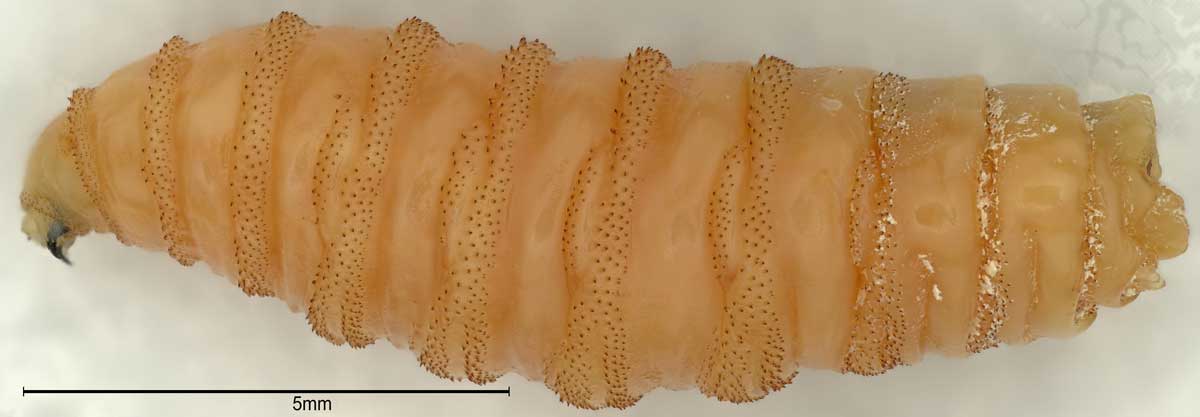
Photo by: Prof. Gary D. Alpert, PhD, of Northern Arizona University, CDC Public Health Image Library
For some background, NWS is native to the Americas and was present in the southern US prior to the 1950s. It led to debilitation and death in cattle and, adjusted for inflation, an estimated hundreds of millions of dollars in loss to producers each year (APHIS, 2025a). In the 1950s, the Panama-United States Commission for the Eradication and Prevention of Screwworm Infestation in Livestock (COPEG) was established and released sterile male flies, also called a sterile insect release technique (SIT) to shift the distribution of NWS west, then south. In 1966, NWS was eliminated from the US and by the early 2000s, Mexico and Central America were declared free of the pest. SIT has been an important component in limiting the distribution of C. hominivorax. For the most part, NWS was restricted to the Darien Gap in Panama and areas south. In 2024, however, Honduras identified a new case of NWS in livestock, and COPEG confirmed the reemergence of flies shifting north. On June 3, 2026, the first US case was identified in Texas in a head of cattle (COPEG, 2026; APHIS, 2026d). An international, One Health approach has been underway to limit the distribution and impact of NWS. Domestically, the USDA and partner agencies are accomplishing this through increased regulatory measures, sterile insect release, field surveillance, and education/stakeholder engagement (APHIS, 2025b).
Life Cycle and Signs of Infestation
The life cycle of C. hominivorax can be as short as 18 days at 29ºC (84.2ºF) but slows in cooler temperatures (Valdez-Espinoza et al., 2025). Adult female flies lay their eggs on edges of wounded skin or mucosa, again on living, warm-blooded hosts. Eggs are laid in batches of 100-300 and hatch within 10-12 hours. Larvae soon begin feeding on wounded tissue, with the ability to travel deep within the body. The hook-like mouth pieces allow the larvae to cause substantial damage even in small wounds. The odors released from the infestation can attract additional flies, both C. hominivorax and other bottle fly species, who then infest the site. Additionally, secondary bacterial infections can develop and should be treated accordingly. 5-7 days after hatching, NWS larvae exit their host to pupate in soil, then emerge as adults in as few as seven days. NWS pupae do not tolerate ground temperatures <46ºF (Valdez-Espinoza et al., 2025; APHIS, 2025b; United States Department of Agriculture [USDA], 2025).
Clinical signs of NWS in animals include bloody discharge at the wound site, a foul odor, and pockets of infestation underneath a relatively small wound. Larvae can be seen around three days after hatching at ~7/10” long, in numbers up to the hundreds. Sometimes, signs can be subtle, and animals may seem depressed, irritated, or be off their feed (APHIS, 2025b). Most of the affected cattle in the current US outbreak have been calves, less than two-weeks-old, who were infested at the site of their umbilicus (navel/belly button). Ideally, all animals should be checked for signs of infestation daily. If that is not feasible, animals can be checked 3-4 times weekly. In addition to the umbilicus, other areas of infestation can include the rectum, sheath, vulva, ears, nose, eyes, and mouth. Castration, dehorning, branding, tattooing, and ear tag placement can also create a nidus for NWS (Texas Board of Veterinary Medical Examiners [TBVME], 2026c; Smith & Banta, 2026; APHIS 2025b).
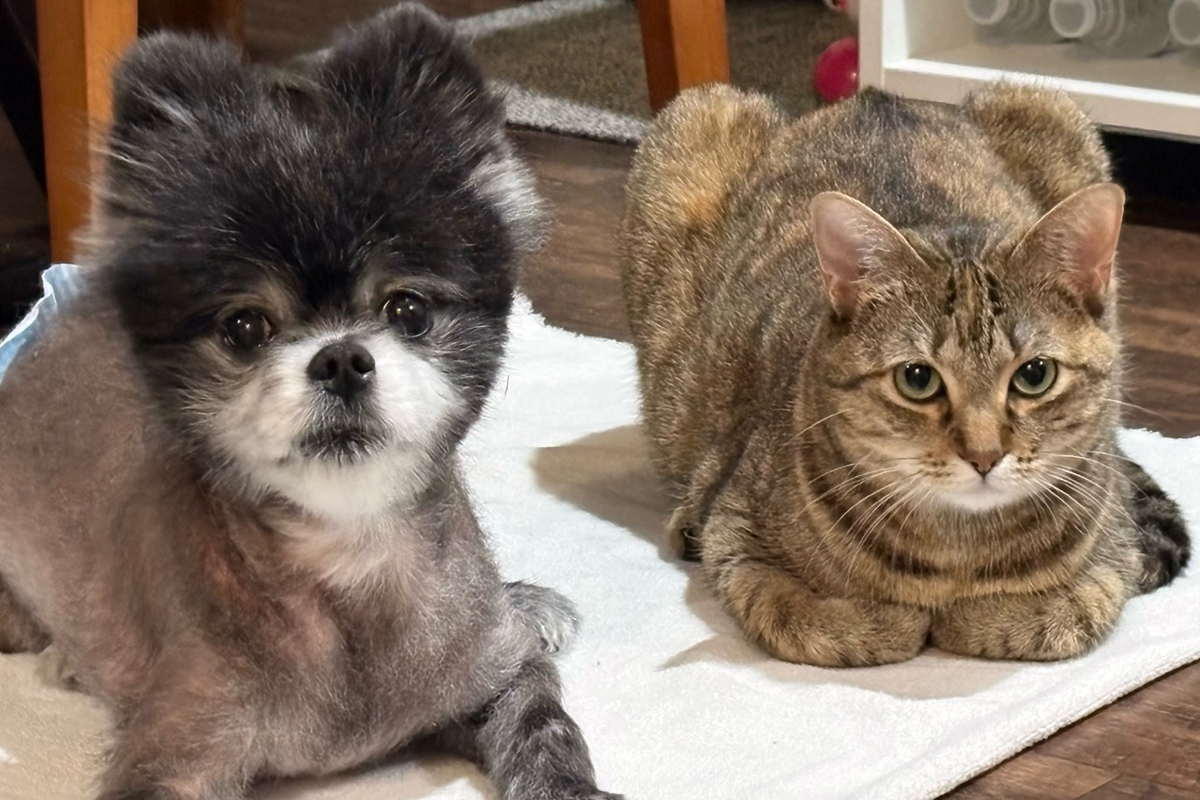
Small and companion animals have a similar clinical presentation as large animals, though the source of their wounds can differ. NWS has been associated with pet ownership status (e.g., stray, owned, etc.), underlying dermatological conditions, co-infestation with other ectoparasites, and traumatic lesions such as bite wounds (de Souza et al., 2010; Cramer-Ribeiro et al., 2003; Verocai et al., 2026).
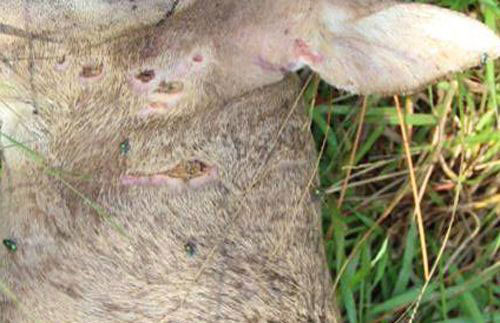
Photo by: Samantha Gibbs, US Fish & Wildlife Service
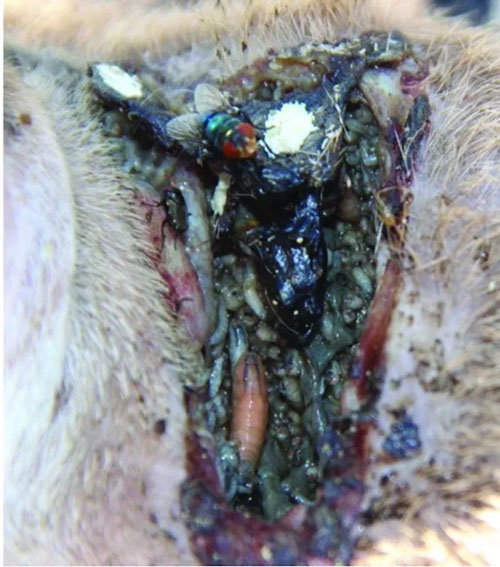
Photo by: Samantha Gibbs, US Fish & Wildlife Service
Reporting, Examination, and Treatment
For veterinarians and other animal health professionals, suspected cases of NWS must be reported to the APHIS Area Veterinarian in Charge (AVIC) and your State Animal Health Official (SAHO).
Additional information on reporting NWS, including for livestock producers, is available here or can be found at screwworm.gov.
When examining or treating NWS-suspicious animals, ensure gloves are worn. If submitting laboratory samples, larvae can be placed in a sealed container of 70% ethanol or ≥70% isopropanol alcohol. This solution will also kill the larvae (APHIS, 2026b; Verocai et al., 2026). Treatment in animals focuses on wound care and anti-parasitic treatment. Further resources are listed below.
Current U.S. Status
As of August 19, 2026, there have been 46 confirmed cases of NWS in the US since June 2026 (4 active and 42 inactive). There have been no domestic cases in humans or wildlife, and except for one dog in New Mexico, all cases have been reported from Texas along the Mexican border. The case breakdown by species is: 47.8% cattle, 34.7% sheep, 10.8% goat, and 6.5% dog. The Animal and Plant Health Inspection Service (APHIS) maintains a dashboard to provide details of current confirmed detections of NWS.
In summary, NWS is an important pest that primarily affects livestock, though any warm-blooded animal can become infested. It is highly treatable, but identification and case reporting are key.
New World Screwworm Resources
General Information & Training
State & Livestock Resources
- State livestock movement and animal health information
- Texas
- Louisiana
- Mississippi
- Alabama
- Florida
- Livestock producer guidance
- New World Screwworm Field Guide for Beef Cattle Producers
Veterinary & Public Health Guidance
- Public health and human medicine
- CDC Information for Public Health Professionals
- CDC Information for Human Medical Providers
Response & Control Resources
- Environmental decontamination
- USDA-APHIS Pesticides for New World Screwworm
Contributing Author
Jill VanWhy-Spoonmore, MPH, LVT
City of New Orleans Mosquito, Termite and Rodent Control Board
References
Alabama Department of Agriculture and Industries. (2026, June 5). Updates. https://agi.alabama.gov/animalindustries/animal-health/imports-requirements/
American Veterinary Medical Association. (n.d.). New World Screwworm (NWS) in livestock and equids: Evaluation and response. https://www.avma.org/resources-tools/one-health/veterinarians-and-public-health/new-world-screwworm/new-world-screwworm-nws-livestock-and-equids-evaluation-and-response
Animal Plant and Health Inspection Service. (2025a, January). Historical Economic Impact Estimates of New World Screwworm in the United States [Fact sheet]. United States Department of Agriculture. https://www.aphis.usda.gov/sites/default/files/nws-historical-economic-impact.pdf
Animal Plant and Health Inspection Service. (2025b, August 14). New World Screwworm Webinar for Veterinary and Animal Health Regulatory Officials [Video]. Youtube. https://www.youtube.com/watch?v=LxPTfFPxlIk
Animal Plant and Health Inspection Service. (2026a, April). Pesticides for the Control of New World Screwworm. USDA. https://www.aphis.usda.gov/sites/default/files/pesticides-for-nws.pdf
Animal Plant and Health Inspection Service. (2026b, April 8). NWS Response: Disposal and Disinfection of Animals and Materials [Fact sheet]. https://www.aphis.usda.gov/sites/default/files/nws-disposal-disinfestation.pdf
Animal Plant and Health Inspection Service. (2026c July). Eradicating New World Screwworm with Sterile Insect Technique [Fact sheet]. United States Department of Agriculture. https://www.aphis.usda.gov/sites/default/files/factsheet-eradicating-nws-sit.pdf
Animal Plant and Health Inspection Service. (2026d, August 6). Confirmed Detections of New World Screwworm. USDA. https://www.aphis.usda.gov/animals/animal-health/livestock-and-poultry-disease/stop-screwworm/current-status/confirmed
Centers for Disease Control and Prevention. (2026a, February 24). Clinical Overview of New World Screwworm. https://www.cdc.gov/new-world-screwworm/hcp/clinical-overview/index.html#cdc_clinical_overview_treat_pat-treatment
Centers for Disease Control and Prevention. (2026b, July 23). New World Screwworm Case Reporting for Health Departments. https://www.cdc.gov/new-world-screwworm/php/reporting/index.html
Cramer-Ribeiro, B. C., Sanavria, A., Monteiro, H. H. M. S., Oliveira, M. Q. D., & Souza, F. S. D. (2003). Inquiry of cases of myiasis by Cochliomyia hominivorax in dogs (Canis familiaris) of the Northern and Western zones of Rio de Janeiro city in 2000. Brazilian Journal of Veterinary Research and Animal Science, 40(1), 13-20.
Companion Animal Parasite Council. (2026, August 14). Cochliomyia hominivorax. https://capcvet.org/guidelines/cochliomyia-hominivorax/
de Souza, C. P., Verocai, G. G., & Ramadinha, R. H. (2010). Myiasis caused by the New World screwworm fly Cochliomyia hominivorax (Diptera: Calliphoridae) in cats from Brazil: report of five cases. Journal of feline medicine and surgery, 12(2), 166–168. https://doi.org/10.1016/j.jfms.2009.08.003
Florida Department of Agriculture and Consumer Services. (2026, July 20). New World Screwworm. https://www.fdacs.gov/Agriculture-Industry/Pests-and-Diseases/Animal-Pests-and-Diseases/New-World-Screwworm
Louisiana Department of Agriculture and Forestry. (2026, June 5). Animal Diseases and Prevention. https://www.ldaf.la.gov/animals/health/diseases-prevention#new-world-screwworms
Mastrangelo, T., & Welch, J. B. (2012). An Overview of the Components of AW-IPM Campaigns against the New World Screwworm. Insects, 3(4), 930-955. https://doi.org/10.3390/insects3040930
Mississippi Board of Animal Health. (2026, June 8). Regulations—Chapter 12—Entry Requirements. https://www.mbah.ms.gov/regulations/chapter-12/
Panama-United States Commission for the Eradication and Prevention of Screwworm Infestation in Livestock (COPEG). (n.d.). Current Situation: New World Screwworm. https://www.copeg.org/en/#1746732598710-268b5ae4-e090
Pezzi, M., Scapoli, C., Chicca, M., Leis, M., Marchetti, M. G., Del Zingaro, C. N. F., Vicentini, C. B., Mamolini, E., Giangaspero, A., & Bonacci, T. (2021). Cutaneous myiasis in cats and dogs: Cases, predisposing conditions and risk factors. Veterinary medicine and science, 7(2), 378–384. https://doi.org/10.1002/vms3.370
Smith, J.K. & Banta, J.P. (2026, July). New World Screwworm Field Guide for Beef Cattle Producers. Texas A&M AgriLife Extension. https://mytexas.ag.tamu.edu/publications/new-world-screwworm-field-guide-for-beef-cattle-producers/
Texas Animal Health Commission. (n.d.). New World Screwworms. https://www.tahc.texas.gov/emergency/nws.html
Texas Board of Veterinary Medical Examiners. (2026a, June). New World Screwworm (NWS): Protect the Animals in Your Care. https://veterinary.texas.gov/wp-content/uploads/2026/06/screwworm-shelter-guidance.pdf
Texas Board of Veterinary Medical Examiners. (2026b, July 6). New World Screwworm: Know Your Enemy [Video]. Zoom. https://veterinary.texas.gov/screwworm-prevention-resources/
Texas Board of Veterinary Medical Examiners. (2026c, July 13). Treating NWS: What You Need to Know [Video]. Zoom. https://veterinary.texas.gov/screwworm-prevention-resources/
Texas Board of Veterinary Medical Examiners. (2026d, July 27). New World Screwworm Updates [Video]. Zoom. https://veterinary.texas.gov/screwworm-prevention-resources/
Texas Board of Veterinary Medical Examiners. (2026e, August 3). Guidance for Animal Shelters Regarding New World Screwworm. https://veterinary.texas.gov/announcements/guidance-for-animal-shelters-regarding-new-world-screwworm/
United States Department of Agriculture [USDA]. (2025, June). USDA Disease Response Strategy: New World Screwworm Myiasis (The Green Book). https://www.aphis.usda.gov/sites/default/files/nws-myiasis-disease-strategy.pdf
United States Department of Agriculture. (n.d.). Standard Operating Procedure for Possible Detections of New World Screwworm in Animals. APHIS Veterinary Services. https://www.aphis.usda.gov/sites/default/files/aphis-sop-detection-nws-in-animals.pdf
US Food and Drug Administration. (2026, August 13). New World Screwworm: Information for Veterinarians. https://www.fda.gov/animal-veterinary/safety-health/new-world-screwworm-information-veterinarians
Valdez-Espinoza, U. M., Fadda, L. A., Marques, R., Osorio-Olvera, L., Jiménez-García, D., & Lira-Noriega, A. (2025). The reemergence of the New World screwworm and its potential distribution in North America. Scientific reports, 15(1), 23819. https://doi.org/10.1038/s41598-025-04804-9
Verocai, G. G., Pimentel de Souza, C., & Ramos, R. A. D. N. (2026). Health impacts and clinical management of New World Screwworm infestation on dogs and cats in a reintroduction scenario in the United States. Journal of medical entomology, 63(3), tjag101. https://doi.org/10.1093/jme/tjag101