Mosquitoes are often referred to as the deadliest animal on the planet, killing untold millions of humans and animals each year. Regardless of the fact that mosquitoes themselves are not the actual root of the disease (that would fall to the pathogens like viruses) it remains that mosquitoes are a major focus of our efforts to reduce human suffering. A major component to decrease adult populations of mosquitoes is to reduce the development of their offspring, which means understanding the sources of their aquatic larvae.
Mosquitoes use two broad categories of aquatic habitat for larval development: open water and container habitats. The former includes large unbounded bodies of water like ponds, ditches, streams, and swamps. Most of these are freshwater but some, like coastal marshes, can contain higher concentrations of salt (although almost no mosquitoes naturally develop in pure salt water). Open water habitats are usually the source of large populations of mosquitoes that transmit pathogens that cause West Nile virus (e.g., Culex mosquitoes) and malaria (i.e., Anopheles). However, container habitats are equally and in some ways a more important habitat for the development of mosquitoes of medical importance.
Containers are isolated small bodies of water existing above the ground level that are used for a specialized group of mosquitoes. They range for a tablespoon of water to many gallons. These containers fall into two categories, natural and artificial. Natural containers often include water found in growing or dead plants. These are known as phytotelmata (meaning “plant tank”), and include structures like plant leaves (bromeliads), flowers (bracts of Heliconia), seed pods, bamboo internodes, and other structures (pitcher plants, palm spathes). Additional natural containers include rock pools that can develop along the banks of streams or near the shore of the ocean and crab burrows used exclusively by mosquitoes in the genus Deinocerites. Around the world there are hundreds of species of plants that are documented to hold water for the development of larvae. Artificial containers include those related to man, including small kiddie pools and outdoor toys, gutters and downspouts on buildings, bird baths, buckets, cemetery vases, and trash. Perhaps one of the most ubiquitous types of artificial containers are used automobile tires. Tires are discarded in the millions every year, and are a on-going and important source of mosquito production. There are over three dozen species of mosquitoes that have been found in tires in the United States alone, including important native and invasive species like Aedes aegypti, Ae. albopictus, and Culex quinquefasciatus. Collectively they are responsible for the spread of many pathogens including dengue, dog heartworm, and West Nile virus.
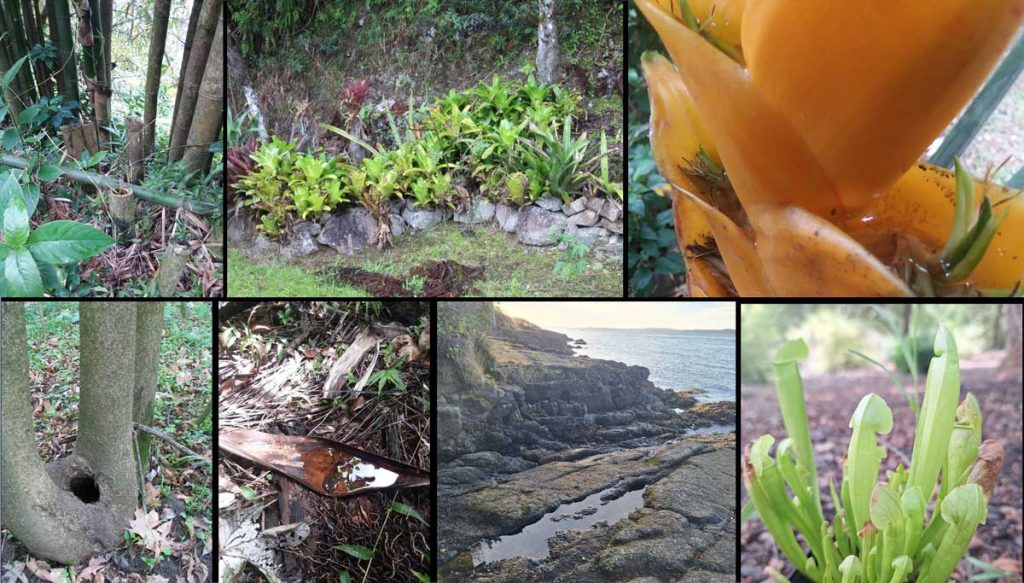
Natural containers are often those found within plants although they can occur elsewhere. Clockwise from the upper left, cut bamboo revealing the water-filled internodes, a collection of bromeliads, a flower of Heliconia (with mosquito larvae visible in the lower right), a pitcher plant, coastal rock pools, a palm spathe, and a tree hole. Photo provided by D.A. Yee.
Control of the larvae that use containers for larval development poses different challenges compared to open water habitats for several reasons. The main reason is that containers are often cryptic, or hidden in the environment, making treating them or their removal difficult. In addition, containers often dry and refill frequently, meaning that their importance as a source of mosquitoes can vary with time, and be more idiosyncratic in terms of weather patterns compared to open water systems. Finally, in the case of tires, there can be overwhelming numbers due to illegal dumping or improper storage, and support to clean up these piles are often tied to limited state or local funds.
Besides removing containers, especially trash and tires, there are no easy solutions to reducing their role in the production of mosquito larvae. If accessible, dumping water and treating with products like Bti is probably the best approach, although shading containers from rain (e.g., large tire piles) may also be effective. With the development of new technologies to find containers, such as drones, there is some hope that reduction of these sources may be more manageable in the future, however containers will remain an important part of the battle against medically important species.
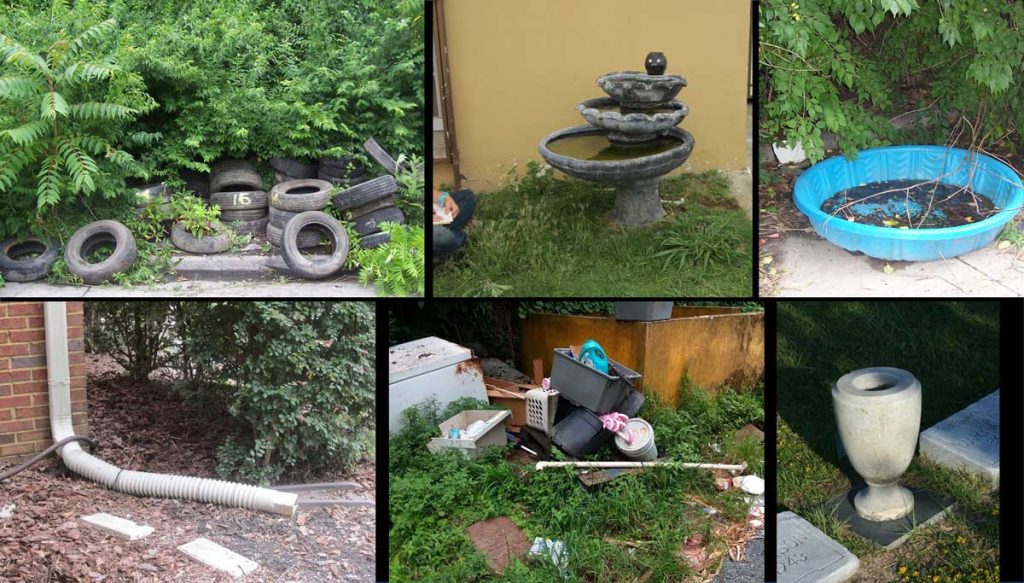
There are a variety of natural containers where mosquito larvae can develop. Clockwise from the upper left, a pile of abandoned tires, a bird bath, a kiddie pool, a cemetery vase, various trash including plastic containers, and a downspout. All of these may naturally fill with water and harbor many different species of mosquitoes. Photo provided by D.A. Yee.
With the development of new technologies to find containers, such as drones, there is some hope that reduction of these sources may be more manageable in the future, however containers will remain an important part of the battle against medically important species.
Contributing Author
Donald A. Yee, Ph.D., BCE
The Yee Mosquito Lab
University of Southern Mississippi