VECTOR
SPOTLIGHT

Why Lyme Disease Is More Common in Some Regions
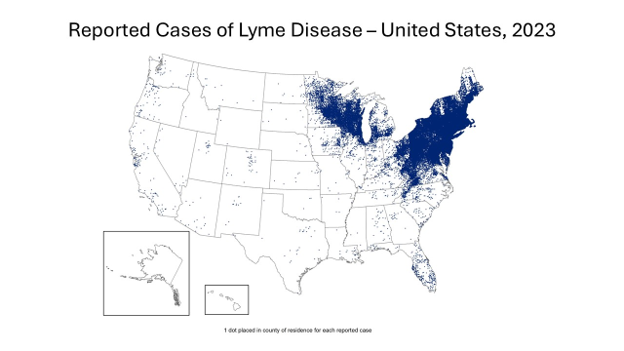
Lyme disease is one of the most common and impactful tickborne illnesses in the United States. Even so, there is a low number of reported Lyme disease cases in the Gulf South region (US Centers for Disease Control and Prevention, 2025a). Cases are concentrated in the Northeast, mid-Atlantic, and upper-Midwest (Fig. 1; US Centers for Disease Control and Prevention, 2025a). Compared to the 89,672 total reported cases in the US, the total number of reported cases in the Gulf South was 353, about 0.4% of the total (Alabama: 36, Florida: 271, Louisiana: 15, Mississippi: 4, and Texas: 27) (US Centers for Disease Control and Prevention, 2025a).
How Lyme Disease is Transmitted
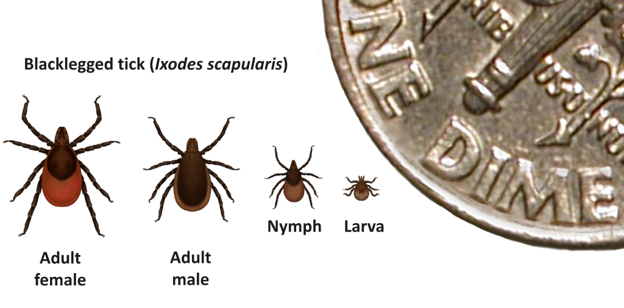
Lyme disease is caused by the bacterium Borrelia burgdorferi and is transmitted by the blacklegged tick (Ixodes scapularis) in the eastern US and the western blacklegged tick (I. pacificus) along the Pacific coast of the US. Ticks acquire this bacterium during their immature larval and nymphal stages while feeding on infected hosts. Nymphal ticks are the most common vectors of the bacteria since they are often unnoticed due to their small size (roughly the size of a poppy seed) (Fig. 2) and because they must pick up the bacteria from a previous host (US Centers for Disease Control and Prevention, 2024b). Ticks search for their host with a behavior known as “questing” (US Centers for Disease Control and Prevention, 2024d). This involves a tick gripping a piece of vegetation with its third and/or fourth pair of legs while waving its first pair of legs out to find and attach to a host. Differential host preferences and questing behavior among northern and southern blacklegged tick populations lead to geographical differences in Lyme disease cases. Also, there are generally less blacklegged ticks found in the southern US compared to the northern US (Ginsberg et al, 2021).
Why the Gulf South Has Fewer Lyme Disease Cases
Blacklegged tick larvae and nymphs have different host preferences in the north versus the south. In the northern United States, immature blacklegged ticks are preferentially found on “good” or competent hosts for the bacteria that causes Lyme disease such as mice, voles, and shrews. In the south, immatures are found on “bad” or poorly competent hosts for the bacteria such as lizards, mainly skinks (Ginsberg et al, 2021). In addition, nymphs (the most common vector life stage) quest at different heights depending on geographical origin. Northern populations stay towards the top of vegetation where they are more likely to encounter humans and southern populations stay in the bottom of the leaf litter (Arsnoe et al, 2019). This helps explain why the Gulf South region has a low incidence of reported Lyme disease cases.
Lyme Disease and Lyme-Like Illnesses in the South
Florida has more reported Lyme disease cases compared to other Gulf South states. Many of the reported cases in Florida are travel-related, meaning the patient likely obtained the bacteria while traveling to an area endemic for Lyme disease (Florida Health, 2016). There is also an emerging disease not caused by B. burgdorferi that leads to Lyme-like illness known as Southern Tick Associated Rash Illness (STARI) (US Centers for Disease Control and Prevention, 2024a) (Masters et al, 2008). It is thought to be transmitted by the lone star tick, Amblyomma americanum, (US Centers for Disease Control and Prevention, 2024a) and could be a source for Lyme-like diseases in the south (Abdelmaseih et al, 2021). Lyme disease can be treated with antibiotics (US Centers for Disease Control and Prevention, 2024c) and although the best treatment for STARI is currently unknown, physicians often prescribe antibiotics (US Centers for Disease Control and Prevention, 2024a).
Other Tickborne Diseases in the Gulf South
Although Lyme disease is not as prevalent in the Gulf South, there are other critical tickborne diseases. Important tick vector species in this region include the American dog tick Dermacentor variabilis which transmits the pathogens for Tularemia and Spotted Fever Rickettsioses, the Gulf Coast tick A. maculatum which transmits a Spotted Fever Rickettsioses, and the lone star tick A. americanum which transmits several viral pathogens and bacteria responsible for tularemia and ehrlichiosis (US Centers for Disease Control and Prevention, 2025b). The best way to avoid infection is with tick prevention and control methods to limit exposure to ticks and the pathogens they can transmit to humans, pets, and livestock. Use the references for further reading on Lyme disease and other tickborne illnesses.
Contributing Author
Jaclyn Martin, Ph.D., Entomologist
City of New Orleans Mosquito, Termite and Rodent Control Board