VECTOR
SPOTLIGHT


Aedes vittatus detected in Mexico – the first country in the North American continent
Biology of Aedes vittatus
Aedes (Fredwardsius) vittatus (Bigot, 1861) is a mosquito species native to tropical regions of Africa, Asia, and the western mediterranean (Melero-Alcíbar 2006, Sudeep and Shil 2017). It is found in forests, savannas, and arid lands, displaying both sylvatic and peri-domestic behavior (Diallo et al. 2012, Obi et al. 2022). It breeds predominantly in rocky habitats and other natural sites such as rock pools, tree holes, and swamp pools (Alikhan et al. 2014, Obi et al. 2022). Due to its ecological plasticity, it has also adapted to breed in other habitats that include domestic containers, hoof prints, cement tanks, cement cisterns, mud pots, and discarded containers like tires (Diagne et al. 2014, Sudeep and Shil 2017, Díez-Fernández et al. 2018, Karuitha et al. 2019).
Aedes vittatus is a competent vector for several arboviruses including yellow fever (Sudeep and Shil 2017), dengue (Mavale et al. 1992), chikungunya (Mourya and Banerjee 1987, Mulwa et al. 2018), Zika (Diagne et al. 2014), and West Nile viruses (Sudeep et al. 2020), making this species a public health risk. It is an aggressive biter and highly anthropophilic, but it also bites animals such as goats, cattle and sheep (Chepkorir et al. 2018). It has a preference to bite during the morning and early evening (Jemberie et al. 2025). Its eggs can resist several weeks of desiccation (Roberts 2004), a key trait that enables invasion and facilitates transport through global trade and travel (Juliano and Lounibos 2005).
Invasion history of Aedes vittatus
Aedes vittatus was first detected in the western hemisphere in Cuba in 2019 with genetic evidence suggests that is originated from the Indian subcontinent (India, Pakistan, and Sri Lanka) (Pagac et al. 2021). In the same year, this species was also found in the Dominican Republic (Alarcón-Elbal et al. 2020). The invasive population further expanded to Jamaica for the first time in 2023 (Noble et al. 2025). In 2024, it was detected beyond the Caribbean Islands and onto the American mainland in the Yucatán Peninsula of Mexico (Tzuc-Dzul et al. 2025). This marks the first country in continental North America where Ae. vittatus is observed. A species distribution modeling suggests that coastal regions of the western, southern, and southeastern US have a high potential for invasion and establishment of this species (Ng’eno et al. 2025).
How to identify Aedes vittatus
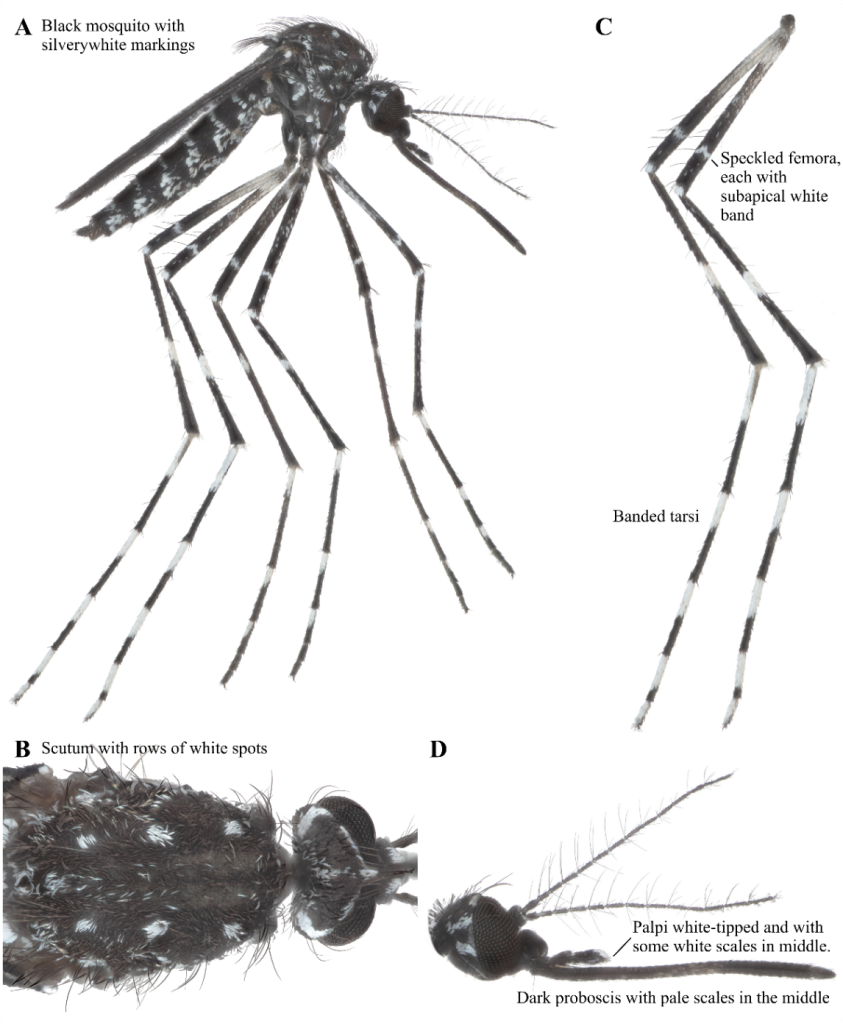
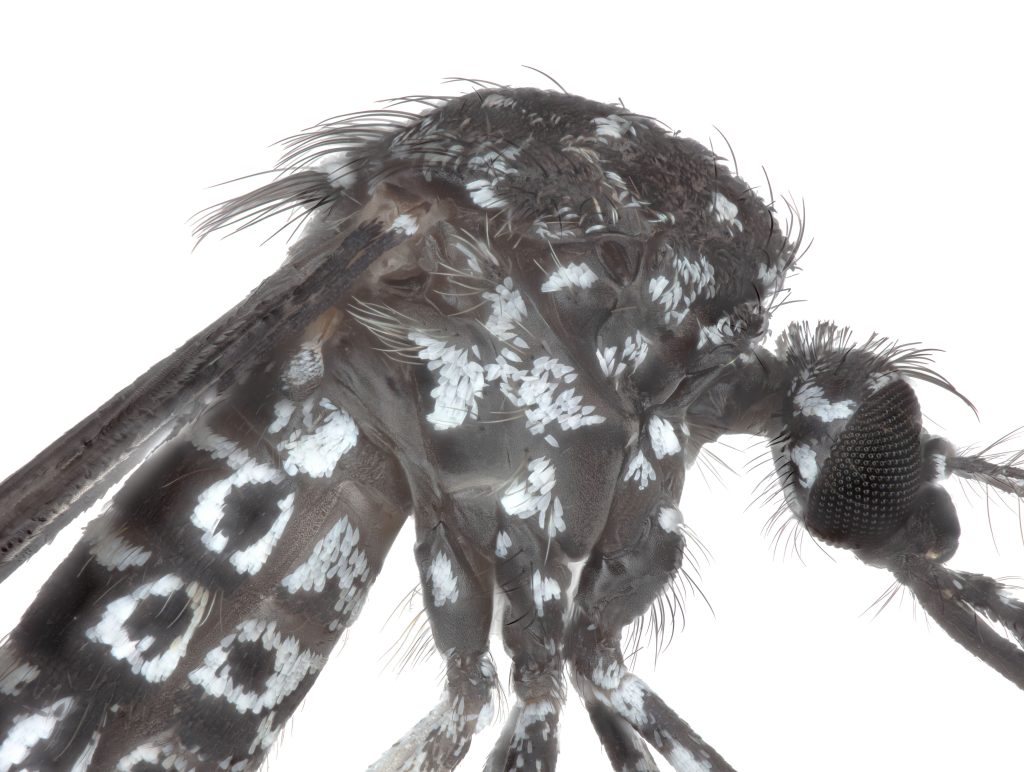
Like most aedine species, Ae. vittatus is a black mosquito complemented with ornate white stripes and spots around the body. However, unlike the linear patterns on the top of the thorax (also known as the scutum) of Aedes albopictus and Aedes aegypti, this species has three pairs of white circular spots that are lined parallel down the center of the scutum (Alarcón-Elbal et al. 2020, Noble et al. 2025). The palps of Ae. vittatus are black with white tips, and the proboscis has pale scales in the middle. The legs of this species are black, and the tarsi are banded like Ae. albopictus and Ae. aegypti, but it sports a subapical band on all femurs. It also has a sub-basal white band located on all three pairs of tibiae (Petersen et al. 2024).
What to do when you spot Aedes vittatus
Although this mosquito has not been detected in the southern US yet, such a possibility exists. If you spot this mosquito in your area, please reach out to Gulf South VECTOR, the state mosquito control association, your local mosquito control district, or the Mosquito BEACONS working group so planning, early detection, and rapid response can be done in your area. We do not know how this competent vector interacts with local fauna and circulating pathogens, and we do not want to wait and see what happens. It is always much cheaper to do prevention than dealing with vectors wreaking havoc.
Article Contributors: Ana L. Romero Weaver (University of Florida), Sangwoo Seok (University of Florida), Jun Soo Bae (University of Florida), Valerie T. Nguyen (University of Florida), Bryan V. Giordano (University of Florida/Azelis), Isabella S. Flores (University of Florida), Michael T. Riles (Central Life Sciences), Lawrence E. Reeves (University of Florida), Yoosook Lee (University of Florida)
Citation References are available upon request.