The Gulf Coast region of the United States provides a subtropical climate that is suitable for a myriad of arthropod disease vectors (mosquitoes, ticks, fleas, etc.) which is a significant factor in the transmission of vector-borne diseases (VBDs) such as Eastern Equine Encephalitis, Lyme disease, and West Nile fever. Pest management professionals (PMPs) and mosquito control districts are the front line of defense against disease vectoring pests. However, when delivering disease vector management services, both PMPs and mosquito control districts encounter operational barriers. While similar in their mission to manage disease vector populations, exact strategies utilized will differ between the two: private companies primarily operate reactively, treating properties after customer requests, and focusing on the elimination of current adult and larval presence. Districts, on the other hand, while engaging in similar reactive measures, also utilize preventive strategies such as disease and population surveillance, source reduction and habitat modification, biological control, and community outreach. Private services can operate within a wide geographic area, while district services are limited to within their jurisdiction, usually a single county or parish. As funding ranges dramatically between districts, from volunteer-ran to operating on a multi-million-dollar budget, the availability and efficacy of district vector control vary greatly. In some areas, private companies may be the only provider of vector control.
In 2023, the Mosquito BEACONS group assessed the capacities of mosquito surveillance and control across the southeastern U.S. Funding, personnel, and were among the highest expressed needs from vector control districts of all budget levels. Less than half of agencies in survey states had a mosquito identification expert on staff. Additionally, despite the high level of global trade at ports along the Gulf Coast that could introduce invasive vectors, only 1 of 26 programs that had a port of entry within their jurisdiction able to perform surveillance there. Other contributing factors, including land use change, high volumes of international trade and travel (increasing likelihood of invasive disease vectors or pathogens being introduced), and poor waste management practices such as illegal tire dumping, all create ideal conditions for the persistent presence of arthropod disease vectors in the Gulf Coast region. Environmental pollution, including damaged septic systems (Louisiana and Mississippi are the only states that utilize septic ditches) and wastewater runoff, further creates mosquito breeding habitats. Climate variability has also expanded the geographic range and seasonal activity of many vectors and the transmission of their associated diseases, further complicating management efforts.
Given the abovementioned barriers that mosquito control districts face in delivering effective vector management programming, pest management companies must also be facing similar challenges. However, given the differences in operations, equipment, and programming, it is likely that PMPs may experience different operational challenges than a vector management district.
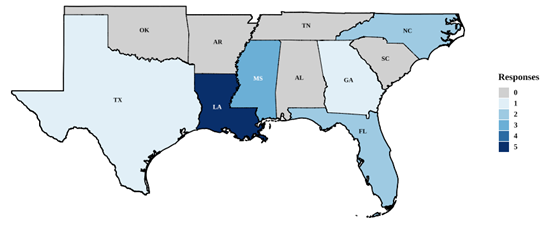
To address this knowledge gap, LSU researchers are conducting a regional needs assessment focused on pest management decision-makers, including company managers, owners, and technical directors. The assessment is conducted with a survey which is administered both in person and virtually, with responses organized and analyzed to identify common themes, operational barriers, and priority training needs. Researchers aim to complete at least 30 interviews with companies in Louisiana and many more across the Gulf South region, providing one of the first comprehensive look at vector-management capacity within the private pest management sector in the region. The project is part of the Gulf South VECTOR initiative and is led by Chance Hudnall, M.S. student, under the direction of Dr. Aaron Ashbrook, from the LSU Department of Entomology in collaboration with Dr. Claudia Riegel at the New Orleans Mosquito, Termite & Rodent Control Board. The survey focuses on identifying knowledge gaps, operational barriers to delivering disease vector management services, and training needs within private pest management companies involved in mosquito and other vector-control services throughout Louisiana and the broader Gulf South. Understanding how these challenges translate to the pest management industry is essential for developing effective training programs and improving regional preparedness for vector-borne disease risks.
From Research to Extension Programming
In addition to documenting the pest management industry’s needs for delivering disease vector management services, the project will support the development of targeted extension programming designed specifically for pest management professionals. Results from the needs assessment will directly guide the design and prioritization of these training and program-development efforts. Potential training and program-development areas include:
- Designing scalable larval surveillance and larviciding programs that can be adapted to different staffing levels, budgets, and equipment availability.
- Developing mosquito identification training programs using multiple instructional formats, including workshops and digital learning tools.
- Evaluating how training influences industry adoption of new vector-control technologies and practices.
- Calibration of mosquito application equipment.
These extension efforts are intended to support pest management companies in implementing more effective and sustainable vector-control programs.
Collaboration Through the Gulf South VECTOR Initiative
This work is being conducted through the Gulf South VECTOR project, a regional effort focused on strengthening vector-management capacity through research, training, and collaboration among universities, mosquito-control programs, and pest management professionals. By working directly with industry partners, Chance Hudnall and the Gulf South Vector team hope to ensure that extension programming reflects the real-world needs of pest management professionals and supports practical, scalable solutions for vector control across the region.
How Can Pest Management Professionals Participate?
Pest management professionals in Louisiana and the Gulf South are invited to participate in the VECTOR needs assessment by participating in a 30-minute interview.
Participation will help researchers:
- Identify industry training priorities
- Improve extension programming for vector management
- Strengthen collaboration between researchers and pest management professionals
- Support regional preparedness for vector-borne disease risks
Interested participants can sign up for the Gulf South VECTOR needs assessment by sign up by completing the online form or contacting the LSU research team.
Name | Phone Number(s) | |
Chance Hudnall | (503) 931-1293 | |
Dr. Aaron Ashbrook | (225) 578-1634 or (225) 578-2257 |